This article examines how obstructive sleep apnea (OSA) is incorporated into cardiovascular disease prevention, screening, and treatment frameworks, reviewing how — and whether — that recognition translates into clinical pathways.


OSA remains largely peripheral in cardiovascular prevention frameworks across most health systems. Disease-specific guidelines — protocols that govern how patients are actually assessed and managed — offer a more revealing picture. Here, integration is somewhat stronger, though gaps remain telling.
One pattern holds across all the jurisdictions examined in a Sleep Institute comparative analysis: OSA is most consistently integrated in hypertension care, moderately in atrial fibrillation, and least in heart failure. The UK is the outlier in a particular direction being not merely limited, but structured around a kind of reverse integration, in which cardiovascular disease is used to prioritize access to sleep services, rather than embedding OSA within cardiology pathways. Japan remains the most systematically integrated at the other end.
Hypertension is where OSA is most consistently recognized and acted upon across all jurisdictions, except the UK.
Across European Society of Cardiology (ESC)-aligned guidelines applied in France and Germany and U.S., Australian, and Japanese frameworks, OSA is identified as a common cause of secondary and resistant hypertension.1 Screening is recommended in patients with suggestive features like resistant hypertension, obesity, snoring, daytime sleepiness, or abnormal nocturnal blood pressure patterns. Diagnosis is confirmed via sleep studies, and positive airway pressure (PAP) and combined lifestyle measures such as weight loss are the main treatment approach for moderate-to-severe OSA, with consistent if modest effects on blood pressure control.
The ESC hypertension guidelines also categorize sleep quantity and quality as behavioral factors within this context going a step beyond the ESC prevention framework, which did not include this.2 Japan takes integration furthest, embedding sleep-related history into standard clinical assessment and framing OSA as a key, modifiable driver of elevated blood pressure through sympathetic activation and intermittent hypoxia.3
The universal caveat applies: PAP has not demonstrated consistent reductions in major cardiovascular events, and this limits its role beyond blood pressure management. In the UK, National Institute for Health and Care Excellence (NICE) hypertension guidance does not mention OSA at all.4
Across Europe, the U.S., Australia, and Japan, atrial fibrillation (AF) guidelines acknowledge OSA as highly prevalent and associated with poorer rhythm-control outcomes, particularly recurrence after cardioversion or ablation. It is increasingly framed as a modifiable risk factor in rhythm management.
But recognition has not translated into standardized screening. Assessment tends to be left to clinical judgment, typically in patients where rhythm-control strategies are actively being pursued. Randomized evidence for PAP improving AF outcomes is inconsistent, which keeps OSA in an adjunctive position rather than a core component of AF care pathways.
Japan again shows the most structured approach, recommending formal sleep studies and incorporating OSA into integrated rhythm management.5 The UK includes no reference to sleep or OSA in its AF guidelines.6
Sleep-disordered breathing is widely recognized as highly prevalent in heart failure populations and associated with worse prognosis. Routine screening, however, is embedded in standard care in very few systems.
Evaluation is generally driven by clinical suspicion, particularly when symptoms persist or treatment response is suboptimal. A recurring and important focus is distinguishing obstructive from central sleep apnea, as management differs substantially: PAP may improve symptoms and cardiac function in obstructive disease, while adaptive servo-ventilation is contraindicated in heart failure with reduced ejection fraction and predominant central sleep apnea due to increased mortality risk.
Japan is again the exception, with active evaluation built into heart failure management pathways, including attention to adherence thresholds for PAP benefit.7 Other systems remain selective and cautious. The UK does not include OSA in routine heart failure assessment.8
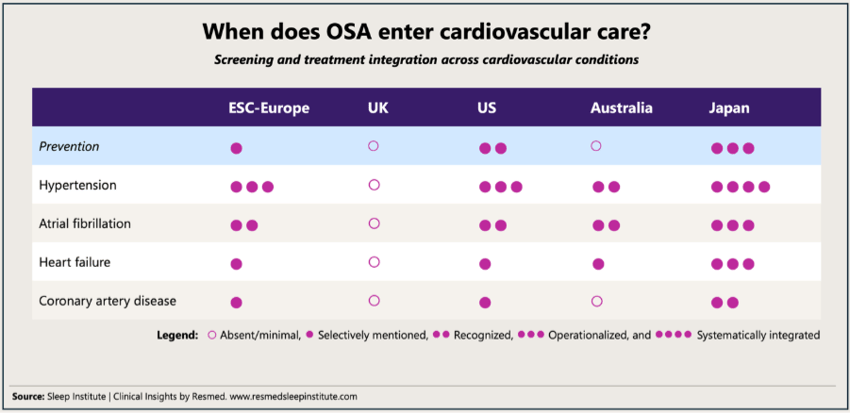
Taken together, the country comparison surfaces a few consistent findings. Hypertension is the point of strongest integration across jurisdictions and is where OSA has made the most concrete progress from recognition to clinical action. Atrial fibrillation sits in the middle as it is recognized yet not systematized. Heart failure remains the most constrained, where the evidence ceiling on PAP outcomes and the specific safety concerns around adaptive servo-ventilation visibly limits how guidelines handle OSA.
The systems that go furthest tend to share two features: Dedicated guidance linking sleep-disordered breathing to cardiovascular disease and more structured collaboration between cardiovascular and sleep medicine disciplines. Where uncertainty about PAP’s cardiovascular outcome benefits dominates the framing, OSA is consistently treated as secondary condition, a comorbidity to be managed rather than a risk factor to be sought.
AMA
Sleep Institute. From recognition to practice: How OSA fits into cardiovascular screening and treatment. Sleep Institute. 2026. https://www.resmedsleepinstitute.com/insights/osa-cardiovascular-screening-treatment
APA
Sleep Institute. (2026). From recognition to practice: How OSA fits into cardiovascular screening and treatment. Sleep Institute. https://www.resmedsleepinstitute.com/insights/osa-cardiovascular-screening-treatment

 Full Article