OSA is now understood as an independent and modifiable cardiovascular risk factor, linked through well-characterized biological pathways including intermittent hypoxia, sympathetic activation, and inflammation to hypertension, coronary artery disease, heart failure, atrial fibrillation, and stroke. The question for policymakers and health systems is practical: Has that understanding made it into the prevention frameworks that shape clinical care?
A Sleep Institute analysis of six major health systems suggests the answer is: Not yet.
Sleep at the margins of prevention
Cardiovascular prevention frameworks continue to organize themselves around familiar, often lifestyle-choice pillars: Smoking, diet, physical activity, blood pressure, lipids, diabetes. Sleep is largely absent from this architecture or appears only at its edges.
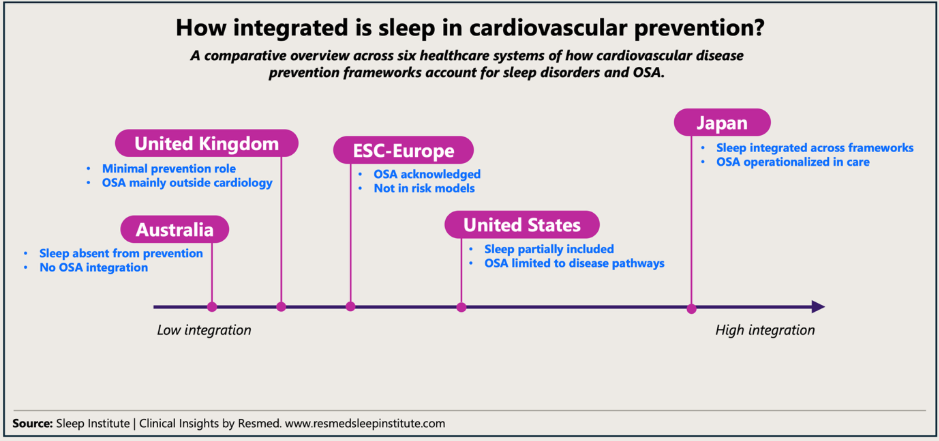
The European Society of Cardiology (ESC) guidelines, which set the template for France and Germany, acknowledge OSA as clinically relevant and note its associations with hypertension, stroke, coronary artery disease, heart failure, and atrial fibrillation.1 But they stop well short of integrating sleep into formal prevention models or core lifestyle recommendations. Crucially, the ESC explicitly states that there is insufficient evidence to include sleep variables in cardiovascular risk prediction models, a position that reflects the current ceiling on translating epidemiological evidence into actionable prevention policy.
The UK goes further in the other direction: National Institute for Health and Care Excellence (NICE) cardiovascular prevention guidelines do not address sleep or OSA at all. OSA is managed through separate sleep medicine guidance, where it surfaces mainly as a clinical priority for patients with unstable cardiovascular disease, a comorbidity lens rather than a prevention one.2,3
The United States offers more. The 2019 American College of Cardiology (ACC) and American Heart Association (AHA) primary prevention guideline acknowledges that short sleep duration and poor sleep quality are associated with elevated blood pressure, and the AHA’s Life’s Essential 8 framework formally includes sleep duration as a component of cardiovascular health.4,5 These are meaningful steps. But the focus remains on sleep quantity as a behavioral metric; OSA as a disorder is not embedded in primary prevention pathways or formal risk models.
Australia’s prevention framework is the most limited of those examined.6 Sleep appears once and only in passing in relation to blood pressure variability and neither sleep nor OSA features in risk prediction tools, screening strategies, or prevention recommendations.
Japan stands in clear contrast. Across the Japanese Circulation Society’s guidelines on cardiovascular disease, coronary artery disease prevention, and heart failure as well as the Japanese Society of Hypertension’s 2025 guidance, sleep is treated not merely as a lifestyle factor but as a diagnostic signal and a treatable disease pathway.7,8 Sleep duration, quality, snoring, and daytime sleepiness are incorporated into routine clinical evaluation. OSA is identified as a major cause of secondary and resistant hypertension, with active screening and positive airway pressure (PAP) treatment built into standard care.
What the comparison reveals
Several patterns emerge from this picture. Sleep integration is consistently stronger within disease-specific guidelines, particularly hypertension, than within broader prevention frameworks. Across all jurisdictions, hypertension is where OSA is most consistently recognized and acted upon; integration within atrial fibrillation pathways is more variable, and within heart failure it is weaker still, constrained by mixed evidence on PAP’s effect on clinical outcomes.
The jurisdictions with the most developed integration (notably Japan) tend to have dedicated guidance linking sleep-disordered breathing to cardiovascular disease and more structured collaboration between cardiology and sleep medicine. Where uncertainty about PAP’s cardiovascular outcome benefits dominates the framing, OSA tends to be treated as a secondary consideration rather than a prevention target in its own right.
From recognition to integration?
Recognition is growing across all the systems examined. The gap between that recognition and its translation into structured prevention frameworks remains the defining feature of where most health systems currently stand. Closing it will likely require both continued refinement of guideline recommendations and growing confidence that practical tools (e.g., home sleep testing, ambulatory monitoring, digital screening) make earlier identification feasible at scale.


 Full Article
