Sleep disorders represent a structurally underrecognized public health challenge across advanced health systems. Conditions such as obstructive sleep apnea (OSA), insomnia, and circadian rhythm disorders are associated with significant cardiovascular, metabolic, neurocognitive, and mental health consequences, yet remain insufficiently integrated into broader chronic disease and prevention frameworks.1,2
Among these conditions, OSA has emerged as one of the clearest examples of the gap between clinical evidence and health system design. A substantial body of research has linked OSA to hypertension, stroke, type 2 diabetes, cardiovascular disease, and increased mortality.3 Despite this, OSA — like many sleep disorders — continues to be managed primarily through episodic or device-based approaches rather than long-term chronic disease models.
To understand the current approach to sleep disorders globally, we can look at systems across six countries representing diverse healthcare models.
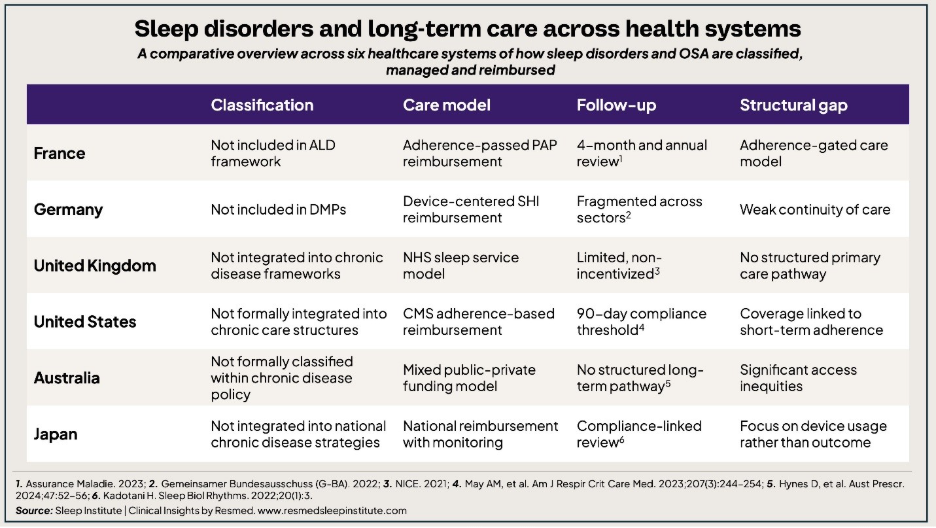
Across these systems, which span Europe, Americas and Asia Pacific, consistent patterns emerge: Sleep disorders remain underdiagnosed, care pathways are fragmented, and reimbursement models frequently prioritize short-term treatment adherence over sustained outcomes and long-term patient engagement. While approaches differ between countries, sleep health remains largely peripheral within national noncommunicable disease strategies.
Several explanations are sometimes offered for this gap. OSA is managed primarily through a device-based treatment model rather than through pharmacological pathways, which has led some systems to classify it under medical device reimbursement frameworks rather than chronic disease management.
Diagnostic complexity — requiring sleep studies interpreted by specialists — makes it harder to integrate into primary care in the way that, say, hypertension screening is. And adherence to positive airway pressure (PAP) therapy is more variable than adherence to many pharmacological treatments, which has encouraged reimbursement models built around short-term compliance thresholds rather than long-term clinical management.4 These are real structural constraints. But none of them change the clinical reality: OSA is a progressive, chronic condition with measurable consequences for cardiovascular, metabolic, and cognitive health.5 The constraints explain the current approach; they do not justify it.
At the same time, some sleep disorders are already recognized within regulatory frameworks as conditions with significant public safety implications. European driving license legislation, for example, restricts driving in individuals with untreated moderate-to-severe OSA unless effective treatment and compliance can be demonstrated.6 This creates a policy inconsistency: Sleep disorders are increasingly acknowledged as clinically and socially significant, yet are not systematically integrated into chronic disease management structures.
Bringing sleep health into the light
The chronic nature of obstructive sleep apnea is well established clinically. What remains hidden is their status within health policy frameworks. OSA is associated with hypertension, cardiovascular disease, type 2 diabetes, and increased mortality. The evidence is extensive and consistent. What has not followed is formal recognition: inclusion in chronic disease classification, integration into prevention strategies, and the long-term care pathways that other conditions with comparable clinical profiles receive as a matter of course.
Making OSA visible — through formal inclusion in chronic disease classification and policy frameworks — would align health system design with clinical reality. The evidence is clear, but the real challenge is recognition.


 Full Article
