OSA is well established as a biologically plausible and independent cardiovascular risk factor linked through well-characterized pathways (intermittent hypoxia, sympathetic activation, inflammation, and endothelial dysfunction) to hypertension, atrial fibrillation, heart failure, coronary artery disease, and stroke. The evidence base has grown substantially over the past two decades. Recognition within cardiovascular guidelines has followed, if unevenly.
What has not followed, in most health systems, is integration.
Three models of integration
The comparative analysis of six major healthcare systems — France and Germany (applying European Society of Cardiology frameworks), the United Kingdom, the United States, Australia, and Japan — reveals three broadly distinct approaches to OSA-cardiovascular care integration.
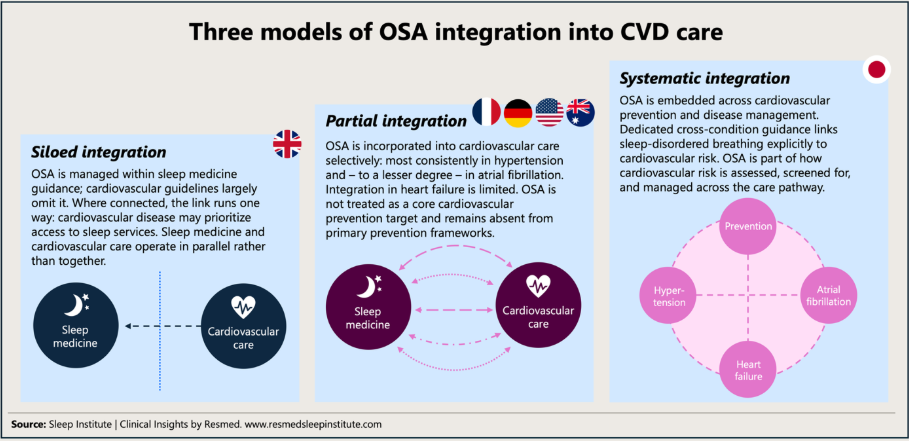
The UK represents the most limited model: Siloed integration. OSA is managed through separate sleep medicine guidance, and cardiovascular guidelines largely omit it. Where the two worlds connect, it is in one direction only. Cardiovascular disease is used to prioritize access to sleep services, but cardiology pathways do not reach back. Sleep medicine and cardiovascular care operate in parallel rather than together.
France, Germany, the United States, and Australia occupy a middle ground: Partial and condition-specific integration. OSA is incorporated into cardiovascular care, but selectively and most consistently in hypertension, where it is widely recognized as a common secondary cause and screening is increasingly standard, and to a lesser degree in atrial fibrillation. It is not treated as a core cardiovascular prevention target, and it is largely absent from primary prevention frameworks and population-level risk assessment tools. The U.S. is notable for the American Heart Association’s (AHA) Life’s Essential 8 including sleep duration as a cardiovascular health metric.1 This is a meaningful step, though one focused on sleep quantity rather than sleep disorders.
Japan represents systematic integration. Sleep history, screening, and OSA management are embedded across cardiovascular prevention, hypertension, arrhythmia, and heart failure frameworks. A dedicated Japanese Circulation Society (JCS) guideline on sleep-disordered breathing in cardiovascular disease provides a unified cross-condition framework.2 OSA is not a specialist add-on; it is part of how cardiovascular risk is assessed and managed.
Why the gap persists
The most frequently cited constraint is the evidence on positive airway pressure (PAP). While PAP consistently improves symptoms, quality of life, and intermediate outcomes — particularly blood pressure control in resistant hypertension — its effect on major cardiovascular events has been variable across randomized controlled trials. This uncertainty has made many guideline bodies cautious about embedding OSA as a primary prevention target.
That caution is understandable, but it may be too narrowly framed. The case for integrating OSA into cardiovascular care does not rest solely on continuous positive airway pressure (CPAP) therapy's effect on hard endpoints. OSA matters for risk stratification, care coordination, blood pressure management, and the broader cardiometabolic profile of high-risk patients. Its prevalence in the populations already driving cardiovascular healthcare utilization — those with obesity, hypertension, heart failure, and metabolic disease — means that leaving it unidentified carries its own costs: Poorer blood pressure control, increased hospitalization, and avoidable morbidity.
Emerging approaches to OSA classification reinforce this point. Frameworks like the Baveno classification3 move beyond the apnea-hypopnea index toward assessments that incorporate cardiovascular comorbidity and end-organ consequences, positioning OSA explicitly within a chronic disease and risk-management context.
What more integrated care could involve
The comparison across jurisdictions points to several practical considerations for health systems looking to close the gap.
Sleep health assessment, including sleep duration, quality, snoring, and daytime sleepiness, could be incorporated alongside established behavioral and metabolic risk factors within cardiovascular risk assessment frameworks. The infrastructure for this largely exists; what is missing in most systems is the guideline mandate.
More structured screening pathways for high-risk cardiovascular populations including patients with resistant hypertension, atrial fibrillation, heart failure, obesity, or metabolic syndrome could build on the progress already made in hypertension care, where the case for OSA screening is now well supported across multiple jurisdictions.
Clearer referral mechanisms between cardiology, primary care, and sleep services would help translate guideline recognition into clinical action. The jurisdictions with the strongest integration consistently combine guidance with practical pathways for diagnosis and management.
Advances in home sleep testing and digital screening tools have reduced the practical barriers to earlier identification, an opportunity that most frameworks have not yet fully reflected.
Finally, continued research is needed on the cost-effectiveness of different screening approaches, on implementation barriers in routine cardiovascular care, and on integrated care models that might improve both adherence and outcomes.
From the periphery toward the center
The overall direction of travel is clear. Across all the systems examined, OSA is moving (gradually) from the periphery of cardiovascular care toward a more central role. The gap between scientific evidence and clinical implementation is real, but it is narrowing.
Whether it narrows further will depend less on additional mechanistic evidence as that case is already strong and more on whether health systems are willing to translate what is known into the prevention frameworks, screening pathways, and care models that shape what actually happens to patients.


 Full Article
